



Why It May Mean A Nest Is Nearby
Wasps are much more active around homes, gardens and business premises during the summer months. By July, many nests are already well established, which means people often start noticing more wasps around rooflines, sheds, garages, wall cavities, gardens and outdoor seating areas.
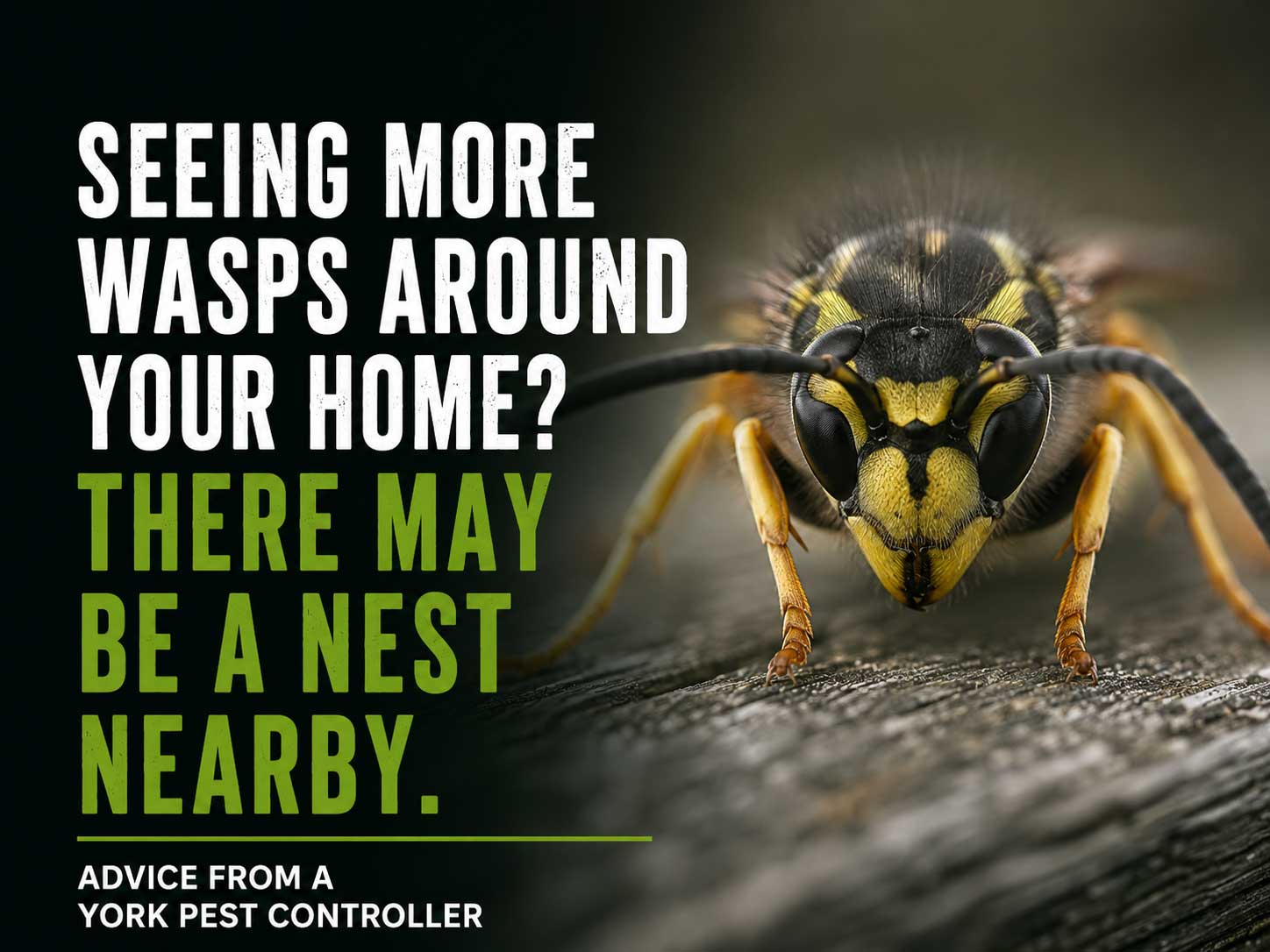
Seeing the odd wasp is normal at this time of year. Seeing several wasps appearing in the same place again and again can be a sign that there is a nest nearby.
For homes and businesses in York, Easingwold, Thirsk, Boroughbridge, Pocklington and the surrounding North Yorkshire area, wasp activity can quickly become a problem if the nest is close to people, pets, staff, customers or regular access points.
Repeated wasp activity is usually the biggest clue
One or two wasps in the garden does not always mean there is a nest on the property. Wasps travel to find food and may be passing through.
The concern starts when wasps keep returning to the same area.
Common signs include wasps repeatedly flying:
- Under roof tiles
- Into soffits or fascia boards
- Around guttering
- Into a hole in brickwork
- Behind cladding
- Into a shed or garage
- Around a hedge, bush or compost area
- Near decking or garden furniture
- Around bins or outdoor food areas
The flight pattern is often quite clear. Wasps may appear to fly in and out of one specific gap, crack or opening. This is usually where they are entering and leaving the nest.
People often describe it as “a steady line of wasps” or “they keep going into the same place”. That is usually worth checking properly.
Why wasp nests become more noticeable in July
Earlier in the year, a wasp nest may be small and easy to miss. As the nest grows, more worker wasps are produced. Their job is to collect food, feed the colony and support the queen.
By July, a nest may contain a large number of wasps and activity can become much more obvious.
This is why a property can seem fine one week and then suddenly appear to have wasps everywhere the next. The nest has often been there for some time, but the level of activity has increased.
Warm weather, outdoor meals, open windows, sweet drinks, bins and garden gatherings can all make the problem feel worse. Wasps are naturally attracted to food and sugary smells, so they may start causing problems around patios, kitchens, cafés, pubs, holiday lets and commercial outdoor areas.
Roof spaces, sheds and garages are common nesting places
Wasps often choose sheltered places where the nest can develop without too much disturbance. In domestic properties, roof spaces and loft areas are common. Wasps may enter through small gaps near tiles, guttering, soffits or fascia boards.
Sheds and garages are also regular places for nests. They tend to be dry, quiet and used less frequently than the main house, which gives the nest time to grow before anyone notices it.
Other possible nesting locations include wall cavities, outbuildings, stables, summer houses, garden rooms and dense hedges.
The nest itself is not always visible. In many cases, the clearest sign is the wasps’ entry point rather than the nest. This is one reason why poking around to find the nest can be risky.
Do not block the entrance to a wasp nest
It can be tempting to block the hole where wasps are going in and out. This is not recommended.
If the entrance is blocked, the wasps may become agitated and look for another way out. In some cases, this can push them further into the property, including into lofts, bedrooms, wall voids or living areas.
Blocking an entrance does not remove the nest. It can make the situation harder to deal with and may increase the risk of people being stung.
The safest approach is to leave the entrance alone and get the problem assessed by a qualified pest controller.
Avoid using household sprays on an active nest
Standard wasp sprays may deal with a small number of visible wasps, but they are not usually suitable for a developed nest in a roof, wall cavity, shed or difficult access point.
Spraying near a nest can disturb the colony. Wasps defend the nest when they feel threatened, and that is when stings become more likely.
This is particularly important if the nest is close to:
- A doorway
- A path or driveway
- Children’s play equipment
- A pet area
- A business entrance
- Outdoor seating
- A loft hatch
- A bedroom window
- A kitchen or food preparation area
A qualified pest controller will use suitable equipment and treatment methods for the location and level of activity.
Wasps can be a particular issue for businesses
Wasp nests are not only a domestic problem. They can create serious disruption for businesses, especially those with staff, customers, tenants or visitors on site.
This can include:
- Cafés and pubs
- Restaurants with outdoor seating
- Farms and stables
- Shops
- Offices
- Holiday lets
- Guest houses
- Schools and nurseries
- Care settings
- Warehouses and workshops
Even a relatively small amount of wasp activity can affect customer confidence if it is close to entrances, seating areas or food areas. For businesses, dealing with the issue early is often the most practical option.
Pest Assured works with both domestic and commercial customers across York and the surrounding area, helping remove wasp problems safely and with minimal disruption.
Wasp stings can be more serious for some people
For many people, a wasp sting is painful but manageable. For others, it can be more serious, especially where there is an allergy or previous severe reaction.
Children, older people, pets and people with known allergies may be at greater risk. Multiple stings can also be more concerning, especially if a nest has been disturbed.
This is why wasp nests close to doors, gardens, roof spaces, sheds and regular walkways should be treated with care.
If someone has a known severe allergy to wasp stings, the nest should not be approached or disturbed.
How to check for signs without putting yourself at risk
You do not need to find the nest yourself. The safest thing to do is watch from a sensible distance.
Look for:
- Wasps repeatedly entering the same gap
- A steady flight path to and from one area
- Increased wasp numbers near rooflines, sheds or garages
- Wasps appearing inside the house without an obvious reason
- Buzzing noises from a loft, wall or ceiling area
- Activity around bins, compost or outdoor food areas
Try to note where the activity is happening and when it seems busiest. This information can be useful when arranging pest control.
Do not climb ladders, lift roof tiles, open panels, enter confined areas or disturb stored items if you think a nest may be present.
What happens when Pest Assured attends a wasp problem
When Pest Assured attends a wasp issue, the aim is to identify the likely nest location, assess the level of activity and treat the nest appropriately.
The exact approach depends on where the nest is, how accessible it is, and whether the property is domestic or commercial.
In many cases, treatment can be carried out without needing to remove the physical nest straight away. Once treated, the wasps return to the nest and the colony is dealt with. Activity usually reduces after treatment, although some wasps may continue returning for a short period while the treatment takes effect.
Advice can also be given on what to expect afterwards and whether any follow-up action is needed.
Local wasp nest removal in York and North Yorkshire
Pest Assured is based near York and covers a practical local area including York, Easingwold, Thirsk, Boroughbridge, Pocklington and nearby villages.
For anyone searching for wasp nest removal in York, wasp control in North Yorkshire or help with wasps around a home or business, a local pest controller can assess the issue and explain the safest next step.
Wasp nests do not usually disappear quickly during the active summer season. If wasps are repeatedly entering the same place, the problem is unlikely to improve on its own in the short term.
If you are seeing regular wasp activity around your home, garden, roofline, shed, garage or business premises, contact Pest Assured for advice.