



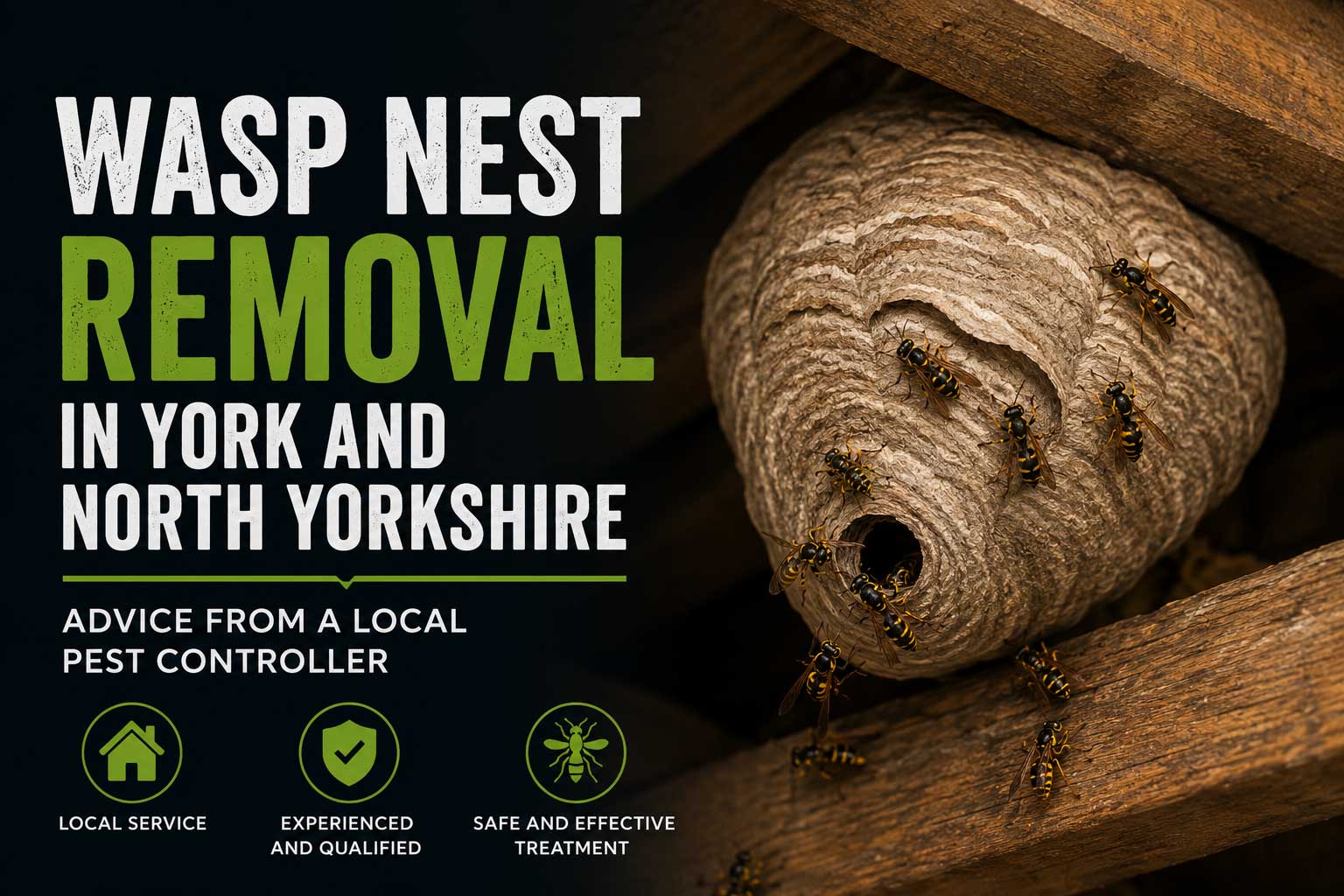
Wasp nests are a common callout for us through spring and summer, especially once the weather warms up and people start spending more time in their gardens, sheds, garages and outdoor seating areas. In the York and North Yorkshire area, we regularly see wasp nests in roof voids, under roof tiles, inside sheds, around fascias and soffits, in wall cavities, garages, outbuildings, hedges and occasionally in the ground.
The main thing I always tell people is not to disturb the nest. It might look small from the outside, or you may only be seeing a few wasps coming and going, but that does not always show the full size of the colony. Wasps can become defensive very quickly if the nest is knocked, sprayed, blocked or interfered with. Once that happens, the situation can become much harder and more dangerous to deal with.
A wasp nest is usually easier to deal with when it is treated properly and left alone beforehand. The problems often start when someone tries to spray the entrance, seal the gap, knock the nest down or use household products around it. That can make the wasps more active, push them into other parts of the property, or increase the risk of people being stung.
How to tell if you may have a wasp nest
The clearest sign is regular wasp activity in the same place. One or two wasps in the garden does not always mean there is a nest nearby. They may simply be foraging. However, if you keep seeing wasps flying in and out of the same gap, hole, roofline, shed, garage, air brick, hedge or wall, there is a good chance there is a nest close by.
Around houses, wasps often use small gaps under roof tiles, around soffits, fascias, guttering and brickwork. The nest itself may not be visible from outside. You may only see the entry point. That is why roof void nests can be easy to miss until the activity becomes obvious.
In sheds and garages, nests are often found in roof timbers, corners, behind stored items or inside areas that have not been disturbed for a while. People often notice the problem when they go into the shed for garden tools, move boxes, or open a garage door and suddenly see a lot of wasps moving around.
You may also hear a low buzzing sound if the nest is in a loft, wall cavity or void. If that happens, it is sensible to leave the area alone and get it checked.
Why wasp nests should be treated carefully
Wasps are not looking to sting people for no reason, but they will defend the nest if they think it is under threat. The closer you get to the nest, the more likely they are to react. This is why DIY treatment can be risky, especially where the nest is in a confined or awkward area.
A wasp sting can be painful, and some people can react badly to them. For anyone with an allergy, a wasp nest near the home, garden, workplace or public area needs to be taken seriously. Even without an allergy, multiple stings can be distressing and can quickly turn a small pest problem into a medical concern.
The other issue is access. Many nests are high up, hidden in roof areas, tucked into sheds or positioned in places where ladders, loft access or close work are needed. Trying to deal with wasps while balancing on steps, reaching into roof timbers or working in a cramped loft is not a good idea.
Professional pest control is not just about having stronger products. It is about knowing where the nest is likely to be, how wasps are using the entry point, how to treat the colony safely, and what not to do.
Wasp nests in roof spaces
Roof spaces are one of the most common places we attend for wasp nest removal in York and North Yorkshire. You might see wasps going under a roof tile, into a small gap near the gutter, or through a gap around the fascia or soffit.
The nest may be inside the roof void, but the entry point can be several feet away from the actual nest. This is why spraying the outside area is often ineffective. It may kill a few wasps near the entrance, but it does not always reach the colony properly.
Another common mistake is blocking the entrance. This can cause wasps to look for another way out. If the nest is inside a roof void or wall cavity, that other route can sometimes be into the property. We have seen cases where wasps have started appearing inside rooms because the outside access point has been sealed too early.
The correct approach is to treat the active nest first. Once the activity has stopped, proofing or sealing work can be considered if needed. Doing it the wrong way round can create more problems.
Wasp nests in sheds, garages and outbuildings
Sheds, garages and outbuildings are also common places for wasp nests because they are sheltered, quiet and often have plenty of small gaps for access. Timber structures can be particularly attractive.
A nest in a shed can become a problem quickly because people often work close to it without realising. Moving tools, bikes, boxes, lawnmowers or garden equipment near a nest can disturb the wasps. The same applies to garages where people are coming in and out regularly.
If you suspect there is a nest in a shed or garage, avoid moving items near the activity. Do not try to knock the nest down. Even if the visible nest looks small, there can be more wasps inside than expected. Keep children and pets away from the area until it has been treated.
Wasp nests near businesses
For businesses, wasp nests can cause practical and safety issues. We often see problems around entrances, bin areas, storage areas, rooflines, outdoor seating, workshops, farm buildings and delivery points.
A nest near staff, customers, visitors or contractors should be dealt with promptly. This is particularly important for hospitality businesses, food premises, care settings, schools, offices, warehouses, farms and any premises where people may be using the affected area throughout the day.
The aim is to reduce risk and disruption. A professional treatment also gives the business a clear record that the pest issue has been addressed properly.
Why you should not block the entrance
Blocking the entrance is one of the most common mistakes with wasp nests. It seems logical, but it can make the problem worse.
If the wasps cannot use their normal route, they may try to find another route. In some properties, that can mean wasps entering the loft, upstairs rooms, offices or internal voids. It can also make the colony more agitated.
The entrance should usually be left open until the nest has been treated and activity has stopped. After that, any gaps can be looked at properly. In some cases, proofing work is useful. In other cases, it may not be necessary. It depends on the building and the access point.
What happens during professional wasp nest treatment
The first step is to identify where the wasps are entering and assess where the nest is likely to be. The visible entry point gives important information, but it does not always show exactly where the nest is positioned.
Once the nest location and activity have been assessed, treatment is applied using professional equipment and protective clothing. The treatment method depends on where the nest is and how accessible it is.
After treatment, it is normal to see wasps returning to the nest for a while. These are often wasps that were away from the nest when the treatment was carried out. Activity should reduce as the treatment takes effect.
The nest itself will not be reused in future years. However, if the building has suitable gaps or access points, another queen could choose a nearby area in a later season. That is why it can be worth checking obvious gaps once the nest is inactive.
Should the old nest be removed?
In many cases, the old nest does not need to be physically removed once it is inactive. Wasps do not reuse an old nest the following year. If the nest is in a loft or roof void and is not causing any further issue, it can often be left where it is.
There are situations where removal may be useful, especially if the nest is accessible, causing concern, or located somewhere that needs repair or maintenance work. However, the priority is always to deal with the active wasps first. Trying to remove an active nest is where the danger lies.
When to call a pest controller
You should call a pest controller if you are seeing repeated wasp activity in the same place, if the nest is close to people, pets, doors, windows, paths, sheds, garages, roof spaces or business areas, or if you are unsure where the nest is.
It is also sensible to get help if the nest is high up, hidden, inside a wall cavity, inside a roof void, or anywhere difficult to access. These are not good situations for trial-and-error treatment.
If someone at the property has a known allergy to wasp stings, the nest should be taken seriously and the area avoided until it has been professionally treated.
Local wasp nest removal across York and North Yorkshire
Pest Assured is based in Huby near York and provides professional wasp nest removal across York and surrounding parts of North Yorkshire. We regularly attend properties in and around Easingwold, Thirsk, Boroughbridge, Haxby, Strensall, Huntington, Pocklington and nearby villages.
We deal with wasp nests in homes, gardens, sheds, garages, roof spaces, commercial buildings, farms, outbuildings and business premises. Every property is different, so the treatment depends on the location of the nest, the level of activity and how the wasps are accessing it.
If you are seeing regular wasp activity around your property, do not spray, block or disturb the nest. Keep away from the area and arrange for it to be checked properly.
For wasp nest removal in York and North Yorkshire, contact Pest Assured.
Call Phil on 07375 775 999
Email enquiries@yorkpests.co.uk