



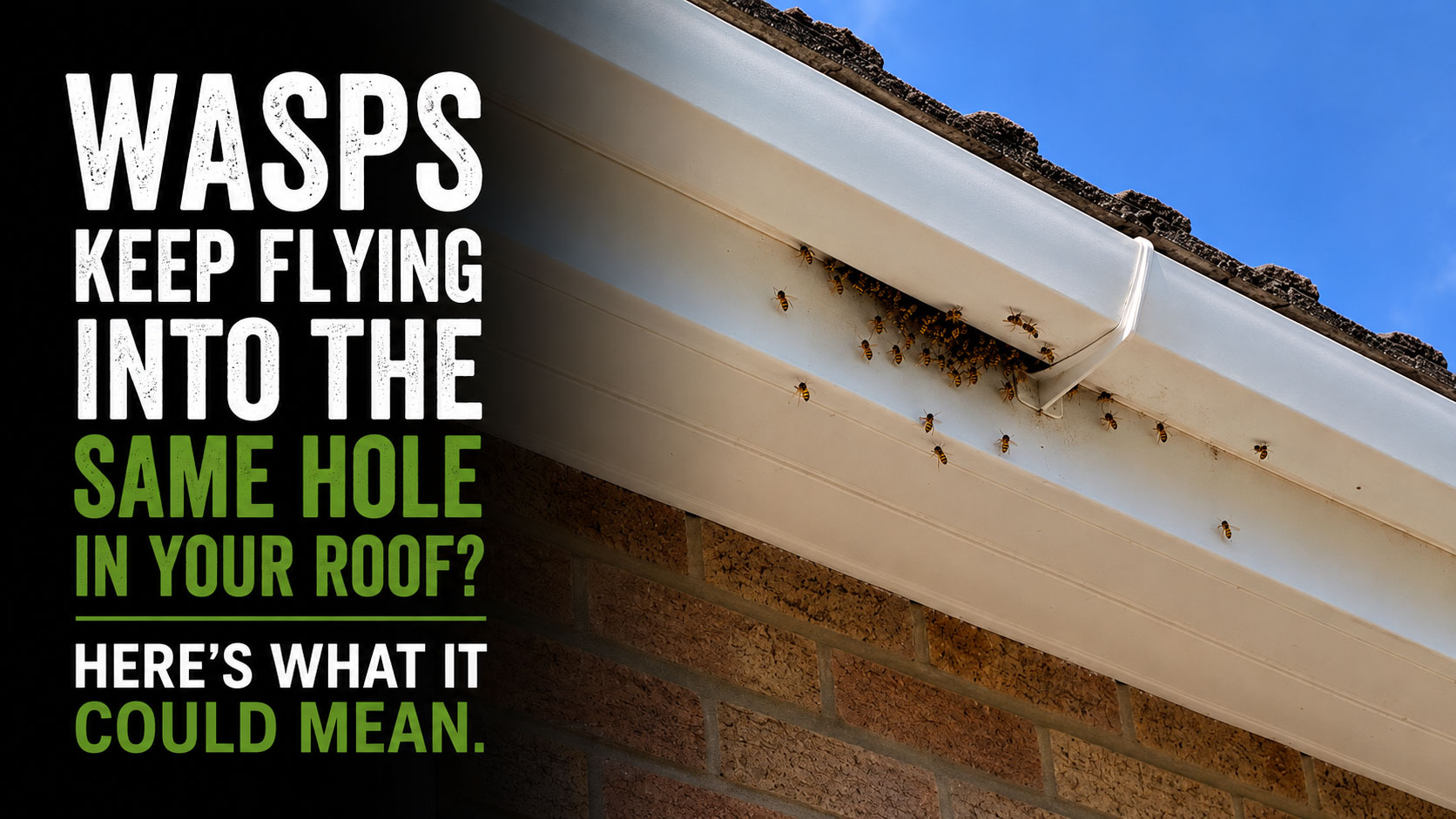
Repeated wasp activity usually points to a nest
Seeing one wasp near the roof of a house is not unusual during summer. Wasps travel considerable distances while searching for food, water and nesting material, so an occasional insect near the guttering does not automatically mean there is a problem.
It becomes more significant when several wasps repeatedly fly towards the same roof tile, soffit, fascia board or gap beneath the guttering.
A steady pattern of wasps entering and leaving one opening usually means they are using it as an access point to a nest. The visible hole is rarely the nest itself. It is normally the route the wasps have found into a protected part of the building.
The colony may be inside:
- The roof void
- An enclosed section of the eaves
- A soffit box
- A cavity behind a fascia board
- A wall cavity
- A gap beneath roof tiles
- An unused chimney
- A flat roof structure
- An extension roof
- A garage or outbuilding roof
The nest may be several feet away from the external opening. Wasps can travel through enclosed sections of a building before reaching the colony.
Why wasps choose roofs and eaves
A developing wasp colony needs a sheltered location where the nest is protected from rain, wind and disturbance.
Roof voids and enclosed eaves provide many of the conditions wasps need. These areas tend to be dry, relatively quiet and protected from sudden weather changes. Small construction gaps also make it possible for the insects to enter without creating a new opening.
Common access points include:
- Gaps beneath roof tiles
- Damaged or displaced tiles
- Openings around soffits
- Gaps where fascia boards meet brickwork
- Cracks in pointing
- Ventilation openings
- Spaces around pipes and cables
- Damaged roofing felt
- Gaps around dormer windows
- Openings beneath guttering
A hole does not need to be large. Wasps can pass through narrow gaps that may be difficult to see from ground level.
Older properties can provide numerous natural access points, but newer houses are not immune. Small gaps can develop through movement, weathering, unfinished sealing work or damage around roof fittings.
Watching the flight path can help locate the access point
One of the clearest ways to identify possible nest activity is to observe the direction in which the wasps are travelling.
Stand at a safe distance and watch the roofline for several minutes. Wasps connected to a nest often follow a recognisable flight path. Some will approach the building, slow down near the entrance and disappear into the same gap. Others will emerge and fly directly away.
The movement can look organised because the insects are travelling between the colony and feeding locations.
Activity may appear stronger during warm, dry periods when more workers are outside collecting food and nesting material. It may seem quieter during rain, cooler weather or later in the evening, but this does not necessarily mean the colony has gone.
Binoculars can be useful when checking a high roofline from a safe position. Avoid climbing a ladder or entering the loft simply to investigate. A nest may be closer than expected, and disturbing it can cause the colony to react defensively.
The hole should not be blocked while the nest is active
Blocking the external opening may appear to be a simple solution, but it can make the situation more difficult.
If an active nest remains inside the structure, the wasps will continue trying to reach it. Those outside may search for another way into the building. Wasps already inside may begin looking for an alternative route out.
This can lead to wasps appearing through:
- Ceiling light fittings
- Loft hatches
- Air vents
- Window frames
- Gaps around pipework
- Cracks in ceilings
- Recessed lighting
- Cupboards beneath roof sections
- Openings around extractor fans
The access point should normally remain open until the nest has been properly assessed and treated. Proofing work can then be considered once activity has stopped.
Sealing the opening too soon does not remove the colony. It only removes its usual route to the outside.
Entering the loft can disturb the colony
People often assume the next step is to enter the loft and find the nest. This is not always necessary and can create unnecessary risk.
A wasp nest may be attached to a roof timber, stored item, insulation layer or roofing felt. It may also be hidden behind insulation or inside an enclosed section that cannot be seen from the main loft area.
Wasps will usually defend the colony when they believe it is threatened. Vibrations, movement, torchlight or contact with the nest can trigger defensive behaviour.
There may also be practical hazards inside the loft, including limited headroom, exposed wiring, unstable boarding and areas where the ceiling beneath will not support a person’s weight.
The external flight path often provides enough information for a pest controller to identify the likely access point and decide how the nest should be approached.
A nest can be present even when it cannot be seen
Many wasp nests treated around York and North Yorkshire are never fully visible.
The colony may be located behind a soffit, inside a cavity or beneath tiles where direct inspection is not possible. In these cases, treatment is based on the activity at the entrance and the construction of the building.
This is why simply looking into the loft and failing to see a nest does not rule out a problem.
Signs that may indicate a concealed nest include:
- Repeated activity at one external opening
- A faint scratching or rustling sound
- Wasps appearing inside upstairs rooms
- Increased activity around an extension roof
- Wasps gathering near a loft hatch
- Insects emerging around ceiling fittings
- A visible flight path between the garden and roofline
The amount of visible activity does not always reflect the full size of the colony. Only a proportion of the worker wasps may be outside at any one time.
Why activity increases as summer progresses
A wasp nest begins with a queen establishing a small colony. As more workers develop, the nest grows and the level of activity around the entrance becomes easier to notice.
Earlier in the season, only a few wasps may be seen using the opening. By July and August, the flight path can become much more obvious.
This can give the impression that the wasps have suddenly arrived, even though the nest may have been developing for several weeks.
Warmer weather can also make the insects more active. More workers leave the colony to collect food and material, creating regular movement around the access point.
Towards the later part of the season, wasps may become more noticeable around bins, fruit, outdoor meals and sweet drinks. However, roof activity still needs to be assessed separately. Wasps feeding in a garden do not always belong to a nest on the same property, whereas repeated entry into one roof opening is a much clearer indication.
Wasps entering a roof are not always entering the house
A nest inside the roof structure does not automatically mean wasps will appear in the rooms below.
In many cases, the colony remains separated from the occupied part of the building. The wasps use the external entrance and have no reason to move towards the interior.
Problems are more likely when:
- The nest is close to a ceiling
- There are gaps around light fittings
- The loft hatch does not close correctly
- The external entrance has been blocked
- Building work disturbs the nest
- The colony is inside a wall cavity
- The nest is close to a bedroom window
- Wasps are attracted to lights inside the property
Even when no wasps have entered the rooms, a nest near a frequently used door, window, patio or pathway may still require attention.
Is every wasp nest dangerous?
A nest in a remote part of a garden or unused outbuilding may not always require immediate treatment. Wasps play a useful role by feeding on other insects, and a colony that presents no practical risk may sometimes be left undisturbed.
The decision depends on the location and the people using the property.
Treatment is more likely to be necessary when the nest is:
- Above an entrance door
- Beside an opening window
- Close to a child’s bedroom
- Near a patio or seating area
- Above a path or driveway
- Inside the main roof
- In a garage used regularly
- Close to pets or livestock
- Near somebody with a known allergy
- Affecting employees or customers at business premises
The number of wasps is only one part of the assessment. The position of the access point and the likelihood of accidental disturbance are equally important.
Spraying the entrance may not reach the nest
Household insect sprays are intended for individual insects and may not deal with a colony concealed inside a roof.
Spraying wasps near the opening can also agitate them without treating the nest. The person applying the product remains close to an active flight path and may be approached by returning workers.
Pouring liquids into the opening or using expanding foam is also unsuitable. The nest may be some distance from the visible hole, while foam can force the wasps to search for another route.
A qualified pest controller will assess the entry point, roof construction, activity level and safest treatment position before deciding how to proceed.
What happens during professional wasp treatment?
The treatment method depends on where the nest is located and how the wasps are entering.
The pest controller will usually begin by observing the flight path and confirming that the opening is active. They will then consider whether the colony can be approached externally or whether access to another part of the building is required.
Treatment may be applied at the entrance so returning workers carry it towards the colony. In other situations, direct treatment of the nest may be possible.
People and pets should be kept away from the immediate area while treatment is carried out. Any specific safety instructions should be followed until activity has stopped.
The nest does not always need to be physically removed. Inaccessible nests are often left in position after they are no longer active, particularly when removal would require damage to tiles, ceilings, soffits or other parts of the building.
Old wasp nests are not normally reused
A wasp colony lasts for one season. The old nest is not normally occupied again the following year.
However, the same roof may provide suitable conditions for a new queen to establish another colony. This does not mean the old nest has been restarted. It means the building still contains attractive shelter and accessible entry points.
Once the current activity has ended, it may be worth inspecting the roofline for maintenance issues such as:
- Loose tiles
- Damaged soffits
- Missing vent covers
- Open joints around fascia boards
- Cracked pointing
- Gaps around cables
- Damaged insect mesh
- Openings around extensions
Any proofing work should be completed carefully so that necessary ventilation is not restricted.
Wasp nest treatment in York and North Yorkshire
Pest Assured deals with wasp activity in houses, garages, sheds, roof voids, wall cavities and commercial buildings across York and the surrounding areas.
Coverage includes York, Easingwold, Thirsk, Boroughbridge, Pocklington and nearby parts of North Yorkshire.
When wasps are repeatedly using the same hole in a roof, avoid blocking the entrance or attempting to inspect it from a ladder. Note the position of the opening, keep people away from the flight path and arrange for the activity to be assessed.
For advice or to arrange a visit, contact Pest Assured on 07375 775 999 or email enquiries@yorkpests.co.uk.