



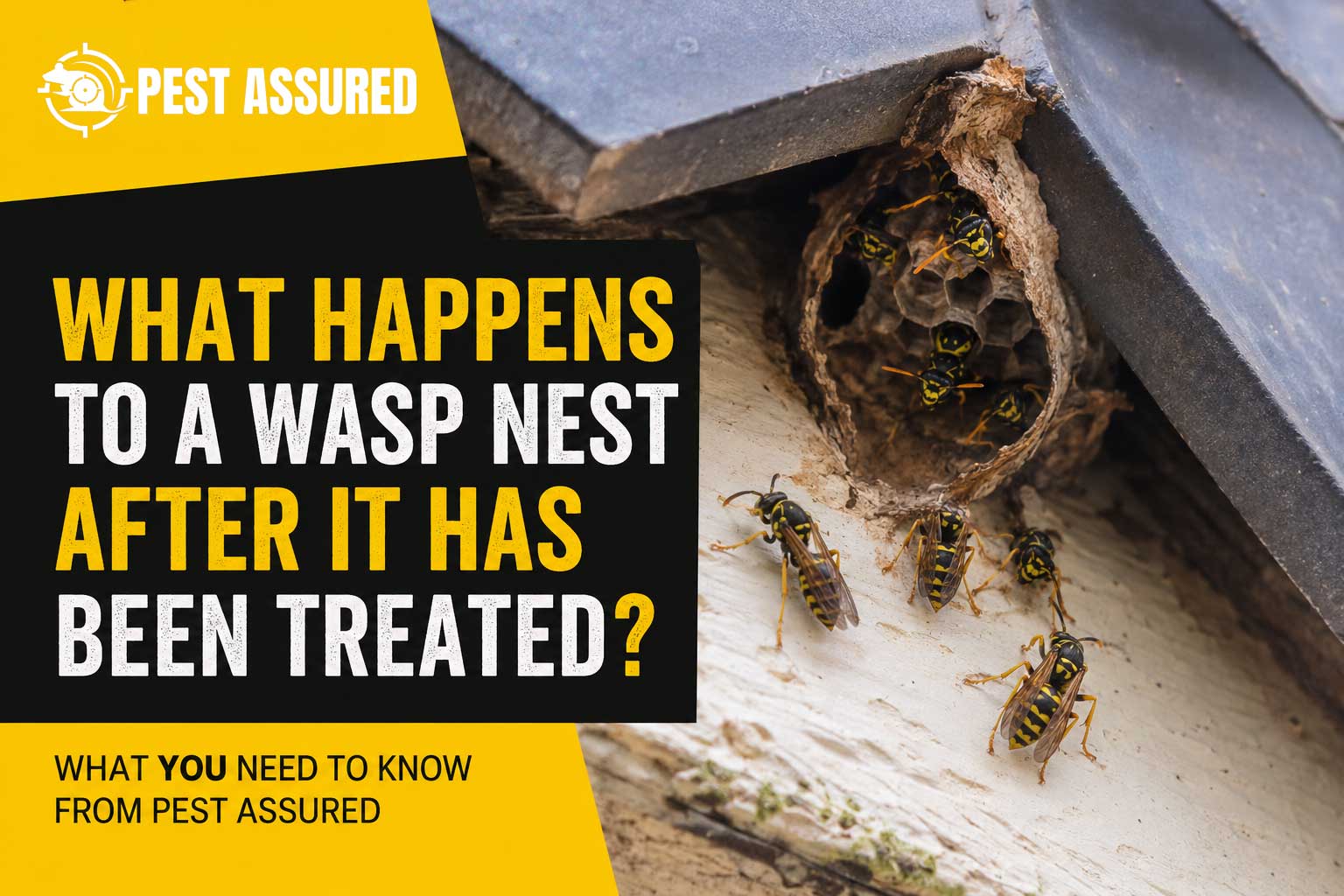
Having a wasp nest treated usually brings a noticeable reduction in activity, but it does not always stop every wasp immediately. The treatment needs time to work throughout the nest, particularly when the nest is hidden inside a roof, wall cavity, shed, loft or other part of a building.
Understanding what happens after treatment can help you avoid disturbing the nest too soon and reduce the risk of being stung.
How Wasp Nest Treatment Works
Wasp nest treatment normally involves applying an insecticidal treatment to the entrance used by the wasps or directly into the nest where it is accessible.
The aim is not simply to kill the wasps visible at the time. The treatment needs to be carried back into the nest by the returning workers. As they continue moving through the entrance and around the nest, the treatment spreads through the colony.
This is particularly important when the nest itself cannot be seen.
Wasps often build nests in places such as:
- Roofs and lofts
- Wall cavities
- Under roof tiles
- Behind fascias and soffits
- Garden sheds
- Garages
- Air vents
- Dense hedges
- Trees
- Underground burrows
In many cases, only the entrance point is visible from outside. The main nest may be several feet away inside the structure.
Treating the access point allows the wasps to continue entering the nest and carrying the insecticide further inside.
How Quickly Does Wasp Activity Stop?
Wasp activity often reduces noticeably within a few hours of treatment. However, some activity may continue for 24 to 48 hours.
The exact timescale depends on:
- The size of the nest
- The position of the nest
- The number of wasps in the colony
- The time of year
- The level of activity before treatment
- Whether the treatment has reached the main nest
- Weather conditions
A large, established wasp nest in July or August may contain many thousands of wasps. It will usually take longer for activity to stop completely than a smaller nest treated earlier in the season.
You may still see wasps arriving at the entrance after treatment. These are often worker wasps that were away from the nest collecting food or nest-building material when the treatment was carried out.
They return to the same entrance because they do not know that the nest has been treated.
Why Are Wasps Still Flying Around After Treatment?
Seeing a small number of wasps after treatment does not automatically mean it has failed.
Wasps leaving and returning to the nest throughout the day may have been away for some time. When they come back, they may hover around the entrance, land nearby or attempt to enter.
Some may appear confused or unusually slow. Others may fall near the entrance or move around on the ground.
This is often a sign that the treatment is taking effect.
There may also be wasps inside the nest that have not yet come into direct contact with the treated area. As the insecticide spreads through the nest, activity should continue to decrease.
The entrance should not be blocked during this period. Blocking it can prevent returning wasps from entering the treated area and may force surviving wasps to search for another way out.
Do Not Block the Entrance Straight Away
One of the most common mistakes after wasp nest treatment is sealing the entrance too soon.
It may seem sensible to fill the hole, cover the vent or block the gap under the roof tile. However, this can cause additional problems.
If the entrance is blocked before the nest is inactive, the wasps inside may attempt to find another exit.
Where the nest is inside a roof or wall, this can result in wasps entering:
- Loft areas
- Bedrooms
- Bathrooms
- Kitchens
- Cupboards
- Ceiling voids
- Other parts of the building
The original entrance should remain open until there is no further activity.
Once the nest is confirmed inactive, repairs can be considered if the gap presents an ongoing maintenance issue.
Will the Wasps Leave the Nest?
Wasps do not normally abandon a treated nest and move together to another location.
The colony depends on the queen and the nest structure. Once the treatment has affected the colony, the remaining workers gradually die.
A few individual wasps may survive outside the nest for a short period, particularly if they were away collecting food. These wasps may continue returning to the original location.
Without a functioning colony, they will not usually establish another nest nearby.
Wasps do not relocate an existing paper nest from one building to another.
Does the Nest Need to Be Removed?
In many cases, a treated wasp nest does not need to be physically removed.
Wasp nests are made from a paper-like material created by chewing wood fibres and mixing them with saliva. Once inactive, the nest gradually becomes dry and brittle.
A nest hidden inside a roof, wall cavity or other inaccessible part of a building can normally be left in place.
Removing it may require:
- Lifting roof tiles
- Removing sections of soffit
- Cutting into walls or ceilings
- Moving insulation
- Dismantling part of a shed or outbuilding
This additional work is often unnecessary unless the nest is causing a separate problem.
An accessible nest in a loft or shed may be removed later if required, but only after it has been confirmed that there is no remaining activity.
Never attempt to remove a nest immediately after treatment.
Will Wasps Use the Same Nest Again?
Wasps do not reuse an old nest the following year.
The colony naturally dies out as the weather becomes colder. New queens leave the nest, mate and find sheltered places to spend the winter.
The following spring, each surviving queen begins building a completely new nest.
An old nest may remain visible for several years if it is protected from damp and disturbance, but it will not become active again.
However, a property that offered a suitable nesting site once may attract wasps again. A new queen may build another nest in the same roof, shed, hedge or loft, sometimes close to the old nest.
This is why it is worth checking the condition of roof edges, vents, fascias and other possible entry points after the treated nest is inactive.
Can the Entrance Be Sealed Later?
Once all activity has stopped, the original entrance can be inspected.
Not every wasp entrance should automatically be sealed. Some gaps form part of the building’s ventilation or roof structure. Blocking them without understanding their purpose could contribute to damp, condensation or restricted airflow.
Where the entrance is caused by damage or poor maintenance, suitable repairs may include:
- Replacing broken roof tiles
- Repairing damaged soffits
- Securing loose fascia boards
- Fitting appropriate insect mesh to vents
- Filling unnecessary cracks
- Repairing damaged mortar
- Replacing missing sealant around pipes
The repair should be suitable for the part of the building involved.
Avoid sealing a hole simply because wasps used it. First check whether it is a ventilation gap or part of the roof design.
Should Dead Wasps Be Cleared Away?
It is common to find dead or dying wasps below the nest entrance after treatment.
These can be swept up once it is safe to approach the area.
Wear gloves and avoid handling wasps directly. A dead or dying wasp may still be capable of stinging if pressure is applied to its body.
Pets and young children should be kept away from the area until fallen wasps have been removed.
Where the entrance is high on a roof, dead wasps may fall into gutters, onto flat roofs or into nearby plants. These will normally disperse naturally, but accessible areas can be cleaned if necessary.
What If Wasps Are Still Active After Two Days?
A small amount of activity within the first 24 to 48 hours can be expected.
If large numbers of wasps are still entering and leaving the nest after this period, the site may need to be checked again.
Possible reasons include:
- The nest entrance was not the main access point
- The nest is further inside the building than expected
- There is a second entrance
- There is another nest nearby
- The wasps are entering a different part of the property
- The treatment has been disturbed or affected by heavy rain
Watching the flight path from a safe distance can help identify whether the wasps are still using the treated entrance.
Do not stand directly below the access point or attempt to inspect it closely.
Could There Be More Than One Wasp Nest?
It is possible to have more than one wasp nest around the same property.
A roof may have activity at the front and rear. A garden may contain one nest in a shed and another in a hedge or underground.
Wasps flying around the property do not always belong to the same colony.
After one nest has been treated, activity elsewhere may become more noticeable because attention is focused on the remaining wasps.
Look for repeated flight paths. Wasps from an active nest tend to travel directly towards a specific entrance rather than flying randomly around the garden.
Common signs of another nest include:
- Regular movement into a second roof gap
- Wasps entering the ground in one location
- Activity around a shed or garage roof
- A steady flight path into a hedge
- Wasps repeatedly entering an air brick or vent
Is It Safe to Enter the Loft After Treatment?
Avoid entering the loft immediately after a nest has been treated, especially when the nest is inside the roof.
Some wasps may be disorientated and moving around inside the loft rather than returning directly to the nest.
Wait until activity has stopped before entering.
When the loft is inspected later, wear suitable clothing, use good lighting and avoid touching the nest. Even when the colony is inactive, the nest may be fragile and surrounded by dead wasps.
If the nest is close to insulation, stored belongings, electrical wiring or pipework, take additional care.
Can Wasps Return Through Windows After Treatment?
Returning wasps may occasionally enter the house through open windows or doors, particularly if the nest was close to the building.
This is usually temporary.
Keep nearby windows closed for the first day if wasps are still active around the treated entrance. Check window vents, loft hatches and extractor vents if wasps appear indoors.
A small number inside the house can often be dealt with safely by opening a window and allowing them to leave. Avoid swatting wasps, as this can increase the chance of being stung.
Repeated indoor activity may indicate that the nest is connected to an internal cavity and should be investigated.
What Happens to the Queen?
The queen remains inside the nest for most of the season.
She produces eggs while worker wasps build the nest, collect food and defend the colony.
When a treatment spreads through the nest, the queen is also affected. Once the queen and workers die, the colony cannot continue.
Later in the season, new queens may already have developed and left the nest. These queens do not return to restart the old colony.
They spend the winter in sheltered places and attempt to build new nests the following spring.
When Should You Arrange Another Inspection?
Arrange a further inspection if:
- Heavy activity continues after 48 hours
- Wasps begin appearing regularly inside the building
- A second entrance becomes visible
- The treated entrance was accidentally blocked
- The nest is in a difficult roof or wall cavity
- Someone at the property has a serious allergy to wasp stings
- The flight path changes to another part of the building
- The nest appears to remain fully active
Do not attempt to apply additional sprays, powders or household products around a treated entrance. Mixing treatments or disturbing the site can make the situation harder to assess.
Pest Assured provides wasp nest treatment for homes and businesses across York, Easingwold, Thirsk, Boroughbridge and surrounding parts of North Yorkshire.
For advice or to arrange a visit, call 07375 775 999 or email enquiries@yorkpests.co.uk.